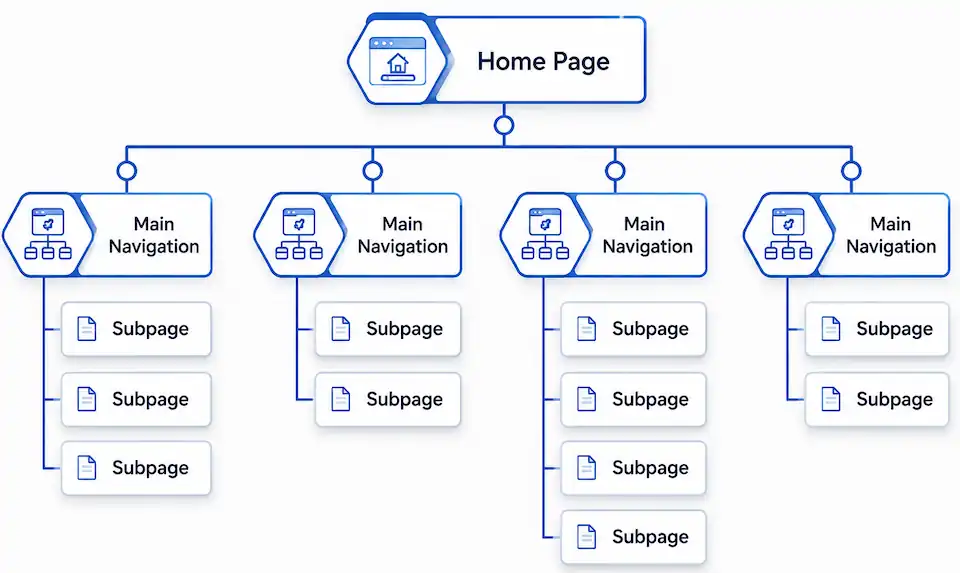
If you run a business website, there is a simple technical SEO question worth asking:
Does your website have a sitemap?
A sitemap helps search engines understand which pages exist on your website and which URLs may need to be discovered and indexed.
For a small business website, it is one of those technical SEO elements that visitors will probably never notice — but search engines can use it to understand your site more efficiently.
What is a sitemap?
A sitemap is a file that provides search engines with information about pages on your website.
For most websites, we are talking about an XML sitemap.
It will often be available at a URL such as:
example.com/sitemap.xml
or:
example.com/sitemap_index.xml
Depending on how the website is built, the exact address can be different.
Why does a sitemap matter?
Google can discover pages by following links throughout your website.
However, a sitemap gives search engines another structured way to discover important URLs.
This can be particularly useful when:
- your website has many pages
- you regularly publish new content
- some pages are difficult to reach through internal links
- your website is relatively new
- you are building a growing blog or resource section
A sitemap does not guarantee that Google will index every page.
It simply helps search engines discover and understand the URLs available on your website.
How can you check your sitemap?
One of the easiest things to try is adding /sitemap.xml to your domain.
For example:
https://example.com/sitemap.xml
If that does not work, you may also see:
https://example.com/sitemap_index.xml
You can also check your website configuration or use Google Search Console to see which sitemap has been submitted.
Should every business website have one?
For a tiny website with only a handful of well-linked pages, Google may be able to discover everything without relying heavily on a sitemap.
But there is usually little reason not to provide one.
As your website grows, a properly maintained sitemap becomes increasingly useful.
Imagine starting with five pages today and eventually having:
- service pages
- location pages
- case studies
- landing pages
- blog articles
- guides
Managing discoverability becomes more important as that content grows.
A sitemap is only one part of technical SEO
Having a sitemap does not automatically mean your technical SEO is good.
Search engines also need to deal with things such as:
- internal linking
- canonical URLs
- robots.txt
- redirects
- duplicate content
- page speed
- mobile usability
- structured data
- crawlability
Think of the sitemap as one part of the infrastructure that helps search engines understand your website.
Final thought
Your sitemap is not something most customers will ever see.
But that is exactly why it is easy to forget.
If you are investing time into creating useful pages and content, make sure search engines have a clear way to discover them.