You can spend thousands of pounds on a new website. It can look professional, load quickly and work perfectly on mobile.
But there is one problem that often gets overlooked, - Nobody is guaranteed to visit it. The numbers behind this are much more extreme than most business owners probably realise.
“96.55% of Pages Get No Organic Traffic From Google”
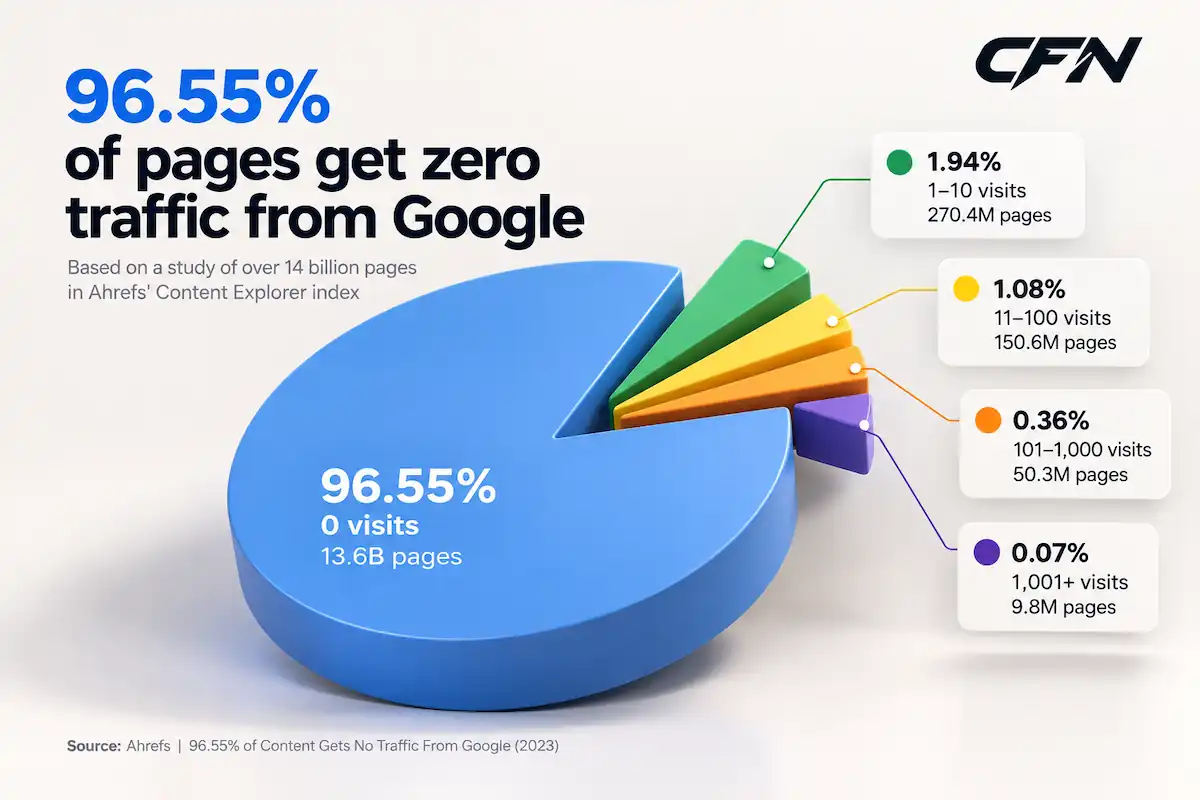
Ahrefs analysed approximately 14 billion pages from its Content Explorer database to understand how much organic search traffic those pages receive. The result was remarkable.
- 96.55% of the pages in the study received zero organic traffic from Google.
- 1.94% received only between one and ten organic visits per month.
- 3.45% of the pages analysed received any measurable organic Google traffic at all.
These figures come from the Ahrefs study: 96.55% of Content Gets No Traffic From Google – Ahrefs
There is an important distinction here, the research looked at individual web pages, not entire websites, and specifically measured estimated organic search traffic from Google.
It does not mean that 96.55% of websites on the internet have no visitors. It does demonstrate something extremely important.
Publishing a website does not automatically create traffic.
A Website and a Website That Gets Found Are Two Different Things. I think many businesses misunderstand when building a website.
If your process looks like this: Build website → publish website → wait for customers.
Unfortunately, the internet does not work like that. Google does not automatically send visitors to a website simply because it exists. Your website is competing with millions of other pages for attention. For every service you offer, there may already be hundreds or thousands of businesses trying to appear for the same searches.
A plumber in Cambridge isn’t simply competing with other plumbers.
Their website is competing with directories, national companies, local competitors, review platforms, Google Business Profiles, advertising and years of existing content.
Why Do So Many Pages Get No Traffic?
According to the Ahrefs research, there are several common reasons. Some are surprisingly simple.
-
Nobody Is Searching for the Topic
You can create the best page in the world. But if nobody searches for what that page is about, Google cannot send meaningful search traffic to it.
This is why keyword research matters.
Before creating a page, it helps to understand what potential customers actually type into Google. There is a significant difference between creating a page called:
“Our Plumbing Solutions”
and understanding that people may search for things such as:
“emergency plumber Cambridge” or: “boiler repair near me”
The wording, structure and purpose of the page should reflect real search behaviour.
-
The Page Has No Authority
Ahrefs also found a relationship between backlinks and organic search traffic. A backlink is simply a link from another website to yours. Search engines can use links as one of many signals when deciding which pages deserve visibility.
A brand-new website with no reputation, no links and very little content may therefore struggle against competitors that have existed for ten years and have been referenced by dozens or hundreds of other websites.
That doesn’t mean every small business needs an enormous link-building campaign. It does mean that uploading five pages and waiting IS NOT a complete SEO strategy.
-
The Page Doesn’t Match Search Intent
Imagine somebody searches:
“best kitchen worktops for a family home”
They are probably researching for comparisons, advantages, disadvantages and examples. Now imagine a company tries to rank a page that simply says:
“Buy our kitchen worktops.”
The page might be relevant to worktops, but it doesn’t necessarily answer what the person was searching for. Google calls this concept search intent. The page needs to match what the person behind the search is actually trying to accomplish.
This Changes How I Think About Building Websites as a developer, it would be easy for me to think my job finishes when a website goes live.
- The pages work.
- The contact form works.
- The website looks good on mobile.
- Lighthouse gives it a great performance score.
✓ Job done!
But from the client’s perspective, that isn’t really the objective. Business wanted something else.
- More enquiries.
- More credibility.
- More people finding their business.
- More customers.
The website is simply the infrastructure that helps make those things possible. Design still matters, a visitor will form an impression of a business extremely quickly, and a poor website can immediately damage trust.
- Performance matters.
- Mobile usability matters.
- Clear navigation matters.
- Strong calls to action matter.
That is why modern web development increasingly overlaps with:
- technical SEO
- content strategy
- local SEO
- Google Business Profile optimisation
- analytics
- conversion optimisation
- structured data
- internal linking
- search intent
- website performance
A website should not exist in isolation, it should be part of the wider system that brings potential customers into the business.
Local Businesses Have an Interesting Advantage
The internet may contain billions of pages, but a local service business does not need to compete with all of them. A roofer in Peterborough doesn’t need to rank globally for “roofing.” They need to be visible when somebody in their service area needs a roofer.
Instead of trying to attract enormous amounts of traffic, a local business can concentrate on highly relevant searches connected to:
service + location + customer intent.
For example:
Roof repair Peterborough or Emergency electrician Cambridge
Ten visitors actively searching for the exact service you provide can potentially be worth considerably more than thousands of random visitors.
The objective isn’t maximum traffic. It’s relevant traffic because Traffic Alone Isn’t the Goal Either Getting visitors is only half of the problem. Once somebody reaches the website, the website has another job. It needs to turn attention into action.
- Can the visitor immediately understand what the company does?
- Can they see where the company operates?
- Can they see previous work?
- Are there genuine reviews?
- Is the business credible?
- Is there an obvious way to call, request a quote or send an enquiry?
This is where web development and conversion optimisation meet.
A website receiving 1,000 visitors but generating no enquiries may have a different problem from a website receiving 20 visitors. The first may have a conversion problem. The second may have a visibility problem. Understanding the difference matters.
Publishing a website has never been easier. AI website builders, templates and page builders can now put something online incredibly quickly. Getting the right people to discover it, trust it and take action is a completely different challenge.
The 3.45% Is the Interesting Part Ahrefs study sounds depressing at first. 96.55% receiving no organic Google traffic sounds like a reason not to bother.
I see it differently this shows why strategy matters. Ahrefs identifies three fundamental areas that can help pages attract organic search traffic:
- Choose topics with genuine search demand.
- Build authority and relevant backlinks where necessary.
- Create pages that properly match search intent.
Add strong technical foundations, good user experience and clear conversion paths, and the website starts becoming something much more useful than an online brochure.
Final Thought?
Building a website is relatively easy. Building a website that loads quickly, represents the business properly and converts visitors is harder. Building one that people can actually discover is another challenge again.
The data from approximately 14 billion pages makes one thing very clear: Being online and being visible online are not the same thing. A website is the foundation, what you build around that foundation determines whether anyone finds it.
⸻
Source: Tim Soulo, Ahrefs, “96.55% of Content Gets No Traffic From Google. Here’s How to Be in the Other 3.45%”, based on an analysis of approximately 14 billion pages in Ahrefs’ Content Explorer database.